
More Alphabet Coloring Pages
About This Printable
Download this free printable coloring page or print instantly. Great for kids, preschool, and classroom activities.
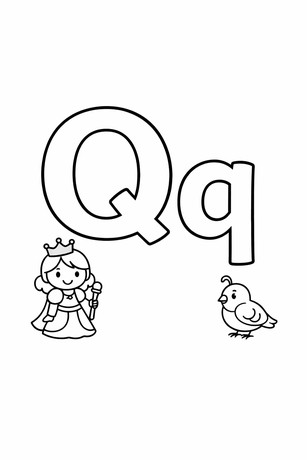
This letter q coloring sheet with tracing is designed for early learners who are practicing letter recognition, beginning sounds, and simple handwriting. It works well for preschool lessons, kindergarten alphabet centers, homeschool practice, and quiet-time activities.
Use it alongside your other letter printables to build a complete A to Z alphabet set. Parents and teachers can also pair it with read-aloud time, phonics games, and simple cut-and-paste activities for more repetition at home or in the classroom.
Browse the Full Alphabet Set
Letter A • Letter B • Letter C • Letter D • Letter E • Letter F • Letter G • Letter H • Letter I • Letter J • Letter K • Letter L • Letter M • Letter N • Letter O • Letter P • Letter R • Letter S • Letter T • Letter U • Letter V • Letter W • Letter X • Letter Y • Letter Z
See all alphabet coloring pages for the full A to Z collection.
Frequently Asked Questions
What words start with the letter Q?
The letter Q begins hundreds of common words that children learn early. Tracing and coloring the letter while thinking of words that start with Q reinforces phonemic awareness — a key early literacy skill. Ask your child to name three Q words while they color.
What is the best way to teach the letter Q to a child?
Multi-sensory practice works best for letter learning: tracing the letter shape, saying its sound, coloring a letter Q sheet, and finding Q words in a book all reinforce the same connection from different angles. This coloring sheet's tracing guide makes it ideal for pencil-grip and letter-formation practice.
Is this coloring page free to download and print?
Yes, completely free. Every coloring sheet on PrintColoringSheet.com is free for personal and non-commercial classroom use. No sign-in, no subscription, and no watermarks — just click Download or Print and you're ready to color.
Can I use this coloring page in my classroom or homeschool?
Yes. All coloring sheets on PrintColoringSheet.com are free for personal and non-commercial educational use, including classrooms, homeschool settings, libraries, and after-school programs. Print as many copies as you need.
Fun Learning
Let’s discover the story behind the letter Q. The original Q likely showed a needle, knot or even a small monkey. The letter represented a throaty ‘k’ sound. Latin writers added a curly tail and paired it with U, a partnership we still see in words like ‘queen’ and ‘quick.’ Over many centuries scribes and artists changed its shape until it became the symbol we see in books today.
Q starts quail, quilt and queen. Search for quiet spots around your house and practise listening carefully. Practise saying 'question', 'quarter' and 'quack'. Use coins to learn about quarters and count by twos.
Design a quilt pattern by drawing different shapes and colouring each square. Make crowns and pretend you are a queen or a king awarding prizes. Create a question box where family members can write questions to ask each other at dinner.
The letter Q has a story that stretches back through several older writing systems. One ancestor was qoph, an old sign with debated origins, so the symbol looked very different before it slowly took on its modern shape. Greek and Roman writers helped pass that form into the alphabet used for English today. Along the way, scribes adjusted angles, curves, and line endings until the letter became easier to copy in manuscripts and print. English made Q especially distinctive by pairing it with U so often. That long journey is what makes even a simple letter like Q feel old and familiar at the same time.
The letter Q holds the seventeenth spot in the alphabet, but its story goes back much farther than modern English. Older alphabets changed shape as they passed from traders to scribes and then into the Roman letters used for English. Today, Q still does a lot of work in names, abbreviations, and words like quill, quartz, and quilt. Because it has a clear place in alphabetical order, you can spot it quickly in indexes, classroom charts, and reference lists. Over centuries of handwriting and printing, scribes kept smoothing the lines until the form became the version we recognize today.