
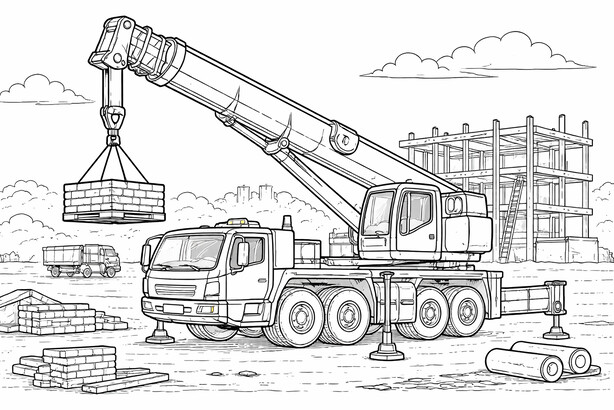
More Construction Vehicle Coloring Pages
About This Printable
Download this free printable coloring sheet or print instantly. Great for kids, preschool, and classroom activities.
Tower cranes are the giants of the construction world — those tall, cross-shaped structures that appear whenever a new skyscraper is rising, lifting steel beams, concrete panels, and heavy equipment hundreds of feet into the air with precise, graceful control. This free construction crane coloring page captures the impressive height and engineering elegance of a tower crane on an active building site.
Children who live in or near cities have almost certainly watched a tower crane at work, and the sight of one pivoting slowly against the sky is genuinely mesmerizing. This coloring page is a great starting point for conversations about how tall buildings get built, why cranes need counterweights, and how construction workers communicate with the crane operator high above the site. It bridges the gap between engineering, physics, and the real-world construction that shapes the skylines kids see every day.
The crane coloring sheet works especially well alongside the excavator and cement truck sheets for a complete urban construction site collection. It's also a natural fit for city-themed art projects, building and architecture units in elementary school, and any kid who has a specific opinion about whether they'd rather operate a crane or drive an excavator when they grow up.
Related Construction Coloring Pages
Fun History
Cranes are machines that lift heavy objects high into the air. The idea of using pulleys and ropes to hoist loads dates back thousands of years. Ancient civilizations in Mesopotamia and Egypt used simple cranes to lift building materials. Greek mathematician Archimedes described compound pulley systems around 200 BC, showing how multiple pulleys could reduce the force needed to lift a weight. During the Middle Ages, builders used human‑powered treadwheel cranes to construct cathedrals and castles; workers walked inside large wheels to wind ropes around drums and raise stones.
The industrial revolution brought steam‑powered and later electric and hydraulic cranes. In the mid‑1800s engineers built cranes with cast‑iron masts and rotating bases, allowing them to swing heavy loads into place. Mobile cranes mounted on railroad cars and trucks followed, making it possible to lift equipment anywhere on a job site. One of the biggest innovations came in 1949 when inventor Hans Liebherr developed the first mobile tower crane, which used a telescoping mast and folding jib to assemble itself and lift materials on high‑rise projects. Today cranes come in many forms, from small workshop hoists to towering tower cranes that help build skyscrapers.
If you see a crane, identify its parts: the mast, jib, counterweights and cables. Discuss how the counterweights balance the load and keep the crane from tipping. Think about why different cranes are used for different jobs – a tower crane for building tall apartments, a crawler crane for heavy lifts on uneven ground, or a small truck‑mounted crane for quick repairs. Learning about cranes shows how clever use of simple machines like pulleys and levers lets us build ever taller and stronger structures.
The Crane is part of the long story of machines built to move earth, lift weight, or prepare ground more efficiently than hand tools alone could manage. As towns expanded into large building projects, construction equipment became more specialized, so each machine developed a shape suited to one main job. That is why a grader looks different from a crane, and why an excavator arm differs from a loader bucket. These machines are easy to recognize because their parts match their purpose. A page focused on Crane shows how modern building work depends on highly specific tools instead of one all-purpose machine.
Frequently Asked Questions
How does a tower crane stay up?
Tower cranes are secured to a massive concrete foundation anchored deep in the ground, and the structure itself is engineered to be in perfect balance — the counterweight on the shorter arm precisely balances the load on the longer jib. The tall mast is designed to flex slightly in wind rather than resisting rigidly.
What colors should I use for a construction crane?
Tower cranes are most commonly painted yellow (Liebherr, Potain), orange (Manitowoc), or red and white (Terex). The structural lattice looks great with alternating colors to show depth. Safety markings and warning stripes in orange/black or red/white are authentic details to add.
Is this coloring page free to download and print?
Yes, completely free. Every coloring sheet on PrintColoringSheet.com is free for personal and non-commercial classroom use. No sign-in, no subscription, and no watermarks — just click Download or Print and you're ready to color.
Can I use this coloring page in my classroom or homeschool?
Yes. All coloring sheets on PrintColoringSheet.com are free for personal and non-commercial educational use, including classrooms, homeschool settings, libraries, and after-school programs. Print as many copies as you need.